
On 28 September 2026, the Ministry of Industry and Information Technology and six other departments jointly issued the “15th Five-Year Plan for the Development of the New Battery Industry” - the first national special plan in China’s battery sector. It puts all-solid-state batteries on a hard national timetable: by 2030, solid-state batteries should initially achieve scaled application, long-life lithium batteries should reach 15,000 charge cycles, and leading companies should hold product defect rates to PPB level.
On the first trading day after the National Day holiday, solid-state battery stocks rallied across the board. But the industrial moves that followed are more substantial than any price move.
Density Nearly Doubled - and a Nail Puncture Stayed at 32°C
Behind the policy lie real technical breakthroughs. CATL (Contemporary Amperex) has opened a 1 GWh all-solid-state pilot line: its laboratory samples hit 500 Wh/kg, nearly double the mainstream ternary battery’s ~260 Wh/kg, with small-batch production targeted for 2027. BYD’s sulfide all-solid-state cell has reached 400 Wh/kg, and its prototype vehicle topped 1,218 km of CLTC range with 5C fast charging - about 500 km recovered in 10 minutes.
What is even more striking is safety: the cell passed the full vehicle-regulation suite of CATARC. Run a steel nail straight through the cell, and the surface peaks at just 32°C - no fire, no smoke. And it still retains over 85% of discharge capacity at -30°C. Swapping volatile liquid electrolyte for solid electrolyte attacks the industry’s oldest pain point - spontaneous combustion - at its root.
At the Mass-Production Yield Gate, Three Hard Mountains
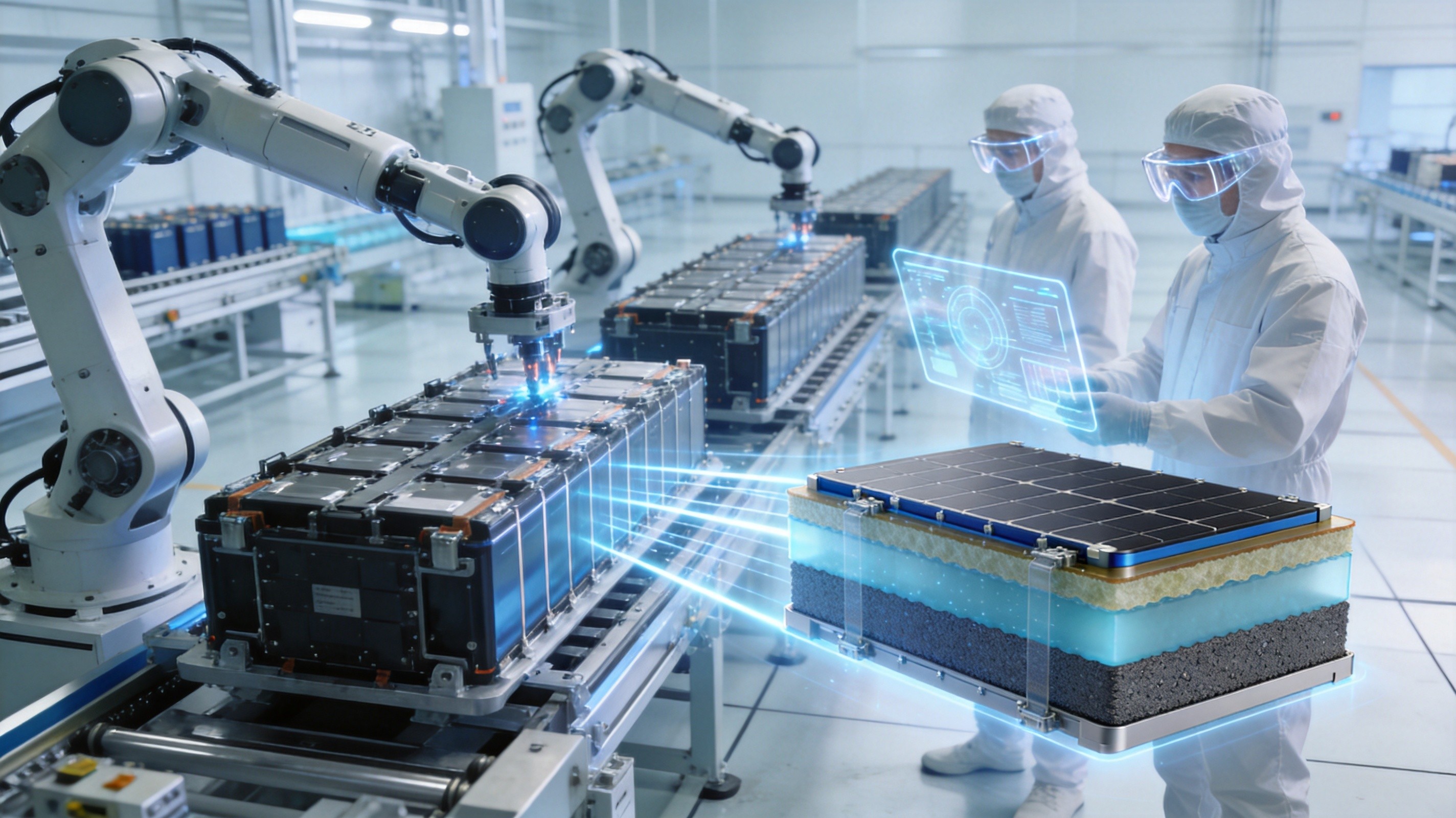
But beautiful lab data is not the same as a production line that can fight. The industry’s math is blunt: between pilot line and mass production sit yield, cost and reliability - three mountains.
First, the solid-solid interface - contact interface impedance soars and cycle life tends to drop. Second, lithium dendrites - lithium-metal anodes can needle through the electrolyte (manufacturers are sidestepping by switching to low-expansion silicon-carbon anodes). Third, brutal manufacturing - sulfides are extremely sensitive to moisture, and the humidity control in a production hall is more demanding than in a chip fab. And fourth, packaging - solid-state encapsulation films crack easily, dragging down yield directly.
The Electrolyte Is Heroic - but the Pack Still Needs Structural Parts to Hold the Bottom
This is the layer many onlookers miss. However the electrolyte routes compete, a battery only becomes “mass-produced in a vehicle” when it is packed, wired to high voltage, and endures vibration and thermal swing. And that rests on a ring of invisible insulation structural parts.
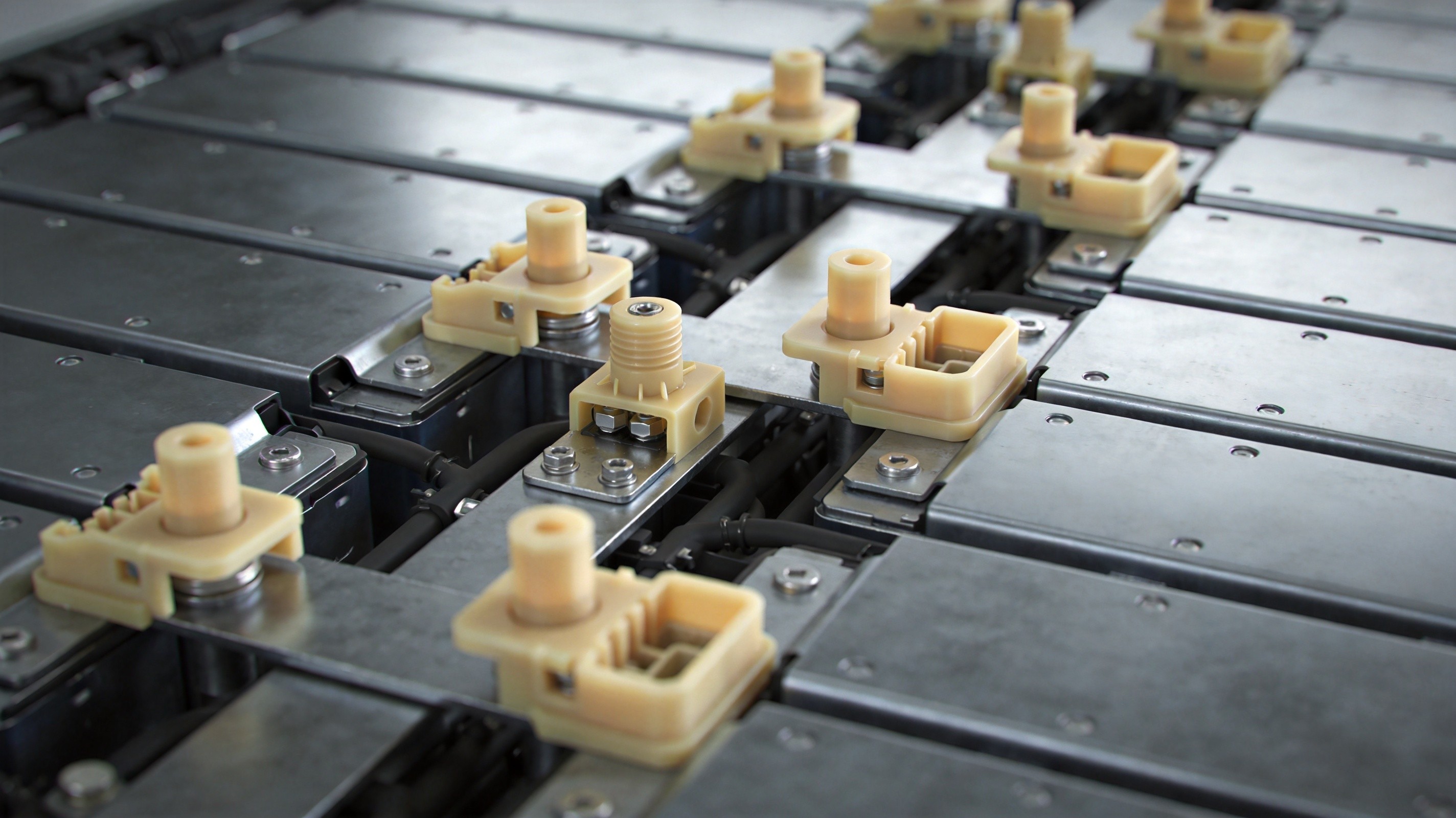
Terminal pole insulation brackets, busbar insulation, high-voltage connector insulation seats and thermal-management seals live permanently in a punishing regime: sustained vibration, thermal swings from -40°C to well over 100°C, and high-voltage soaking. Historically these parts used PC, PPS or PBT - fine for a while, but under long-term aging, high-low temperature cycling and high-voltage immersion they suffer falling insulation resistance, softening and brittle cracking, and cracked insulators that risk short-circuits between anode and cathode. Over an 8-15 year vehicle service life, that does not hold.
Why the Industry Turns to PEEK
So the industry is turning to PEEK (polyetheretherketone), a semi-crystalline specialty engineering plastic. PEEK melts at 343°C, serves continuously at 260°C and shrugs off short spikes above 300°C. Its high dielectric strength and volume resistivity - >1×10¹&sup6; Ω·cm across a wide temperature range - block leakage paths between modules.
More decisive than heat resistance and insulation is long-term stability: PEEK is creep-resistant, dimensionally stable and low-absorbing, so it keeps its constraint and insulation precision over a decade of battery-pack service in high humidity - exactly the gap ordinary engineering plastics cannot cross and PEEK can hold.
How PEEK “Goes to Work” Inside a Solid-State Pack
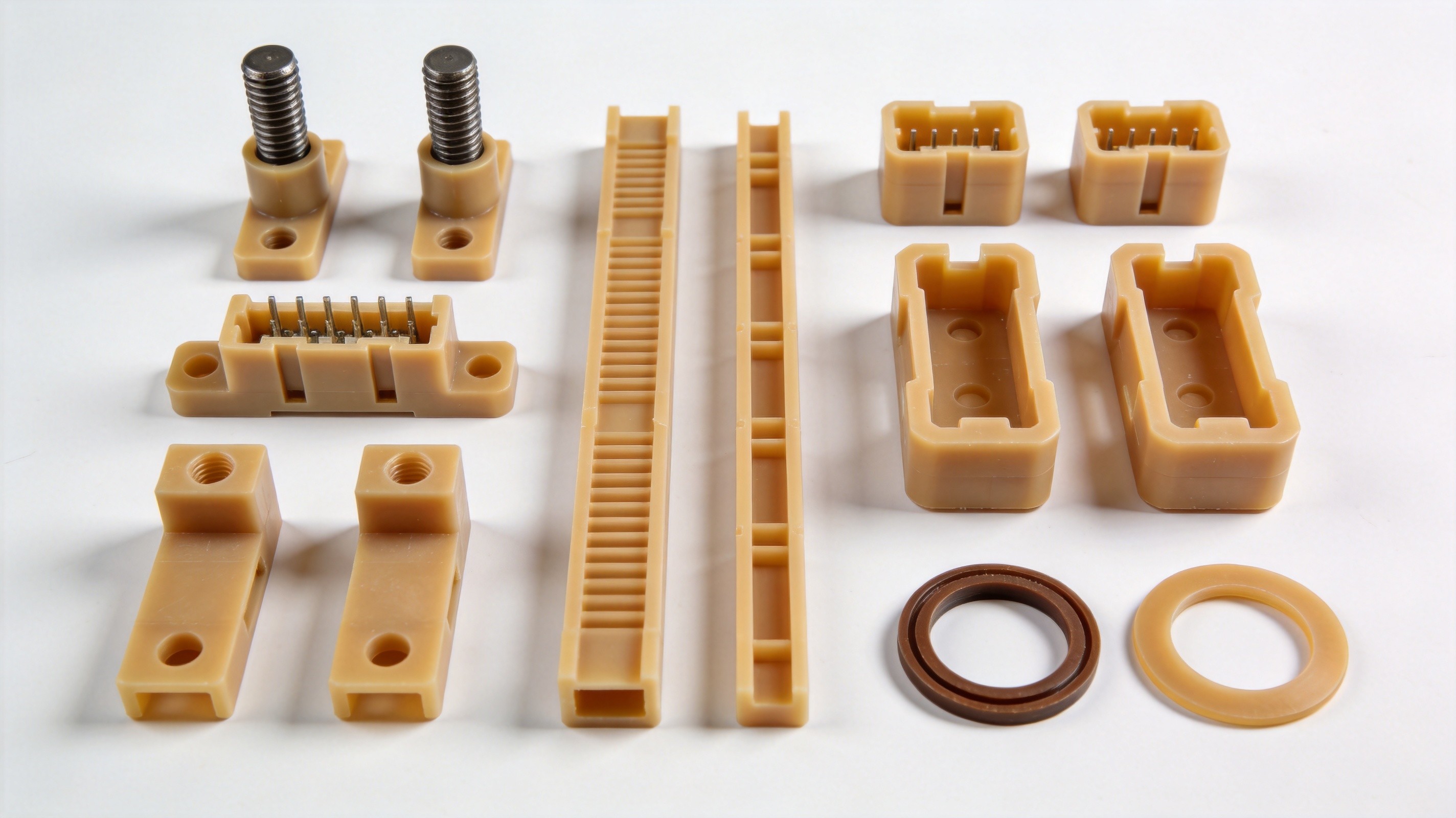
PEEK does not replace the electrolyte - it carries the structure under the electrochemical system. It makes terminal pole insulation brackets that keep insulation and positioning accuracy under high energy density and high current; high-voltage connector insulation seats that withstand steep voltage gradients and repeated plug-pull friction; busbar insulation structures that block leakage paths between modules; and thermal-management seals that resist aging across large temperature swings without leaking.
Above all, for a high-energy-density, high-voltage, large-thermal-swing system like all-solid-state, the demands on insulating parts for high-voltage endurance, damp-heat resistance and creep resistance only get higher. No matter how advanced the electrolyte, this ring of load-bearing insulators has to hold out first.
Carrying “That One Step to Mass Production” with PEEK
These requirements land exactly on the capabilities of Dalian Luyang Technology and Beijing Yuchuan New Materials. Dalian Luyang works deep in the modification, injection molding and precision machining of PEEK specialty engineering plastics, mass-producing terminal pole insulation brackets, high-voltage connector insulation seats, busbar insulation structures and thermal-management seals - squarely matching the high-voltage insulation, heat resistance, creep resistance and long-term safety demanded by solid-state battery packs.
The electrolyte decides the performance ceiling; the insulation structural parts decide whether it can be mass-produced into a vehicle. When a PEEK insulator holds for ten years under 500 Wh/kg of pressure without degrading, domestic specialty engineering plastics are, with the word “foundation,” supporting the next generation of batteries from the line to millions of garages.