
Here is the conclusion first: on October 20, 2026, the US firm Atomic-6’s composite protective panel “Space Armor” flew into orbit aboard Portal Space Systems’ Starburst-1 satellite, launched by a Falcon 9 rocket. It was the first time this material was mounted on an operational in-orbit satellite. And what it defends against is the orbital debris flying at 7–8 km/s — that ever-denser “bullet rain” over our heads.

01 Overhead, There Hangs a “Bullet Rain”
In the 2013 film Gravity, Sandra Bullock hung by a thread amid a storm of debris. At that time only about 1,000 satellites worked in Earth orbit. Today that number has climbed toward 16,000 — of which SpaceX’s Starlink alone accounts for about 11,000 — and the total number of trackable human-made objects exceeds 46,000. Space has gotten crowded, and danger has moved closer: those “dead” fragments do not disappear on their own. In low Earth orbit, a few hundred kilometers up, anything flies at about 7–8 km/s — more than seven times the muzzle velocity of a rifle bullet (about 1 km/s).
02 Most Lethal Fragments Are Too Small to See
A 1-cm aluminum chip hitting at low-Earth-orbit speed has kinetic energy roughly equal to a 1-ton family car crashing into a wall at 80 km/h. Worse, most lethal fragments are too small to see: by the ESA space-environment report scope, orbit holds about 54,000 pieces larger than 10 cm, some 1.2 million between 1 and 10 cm, and hundreds of millions under 1 cm. The windows of the International Space Station are already pitted with visible micrometeoroid impact craters — each one from a “bullet” smaller than a grain of sand. A 1-cm fragment can pierce a satellite’s hull, battery or bus system and end a mission outright. This is the reality every satellite faces today.
03 A Batch of “Composite Armor” Went to Space for the First Time
Last week something new put “how to shield a satellite from debris” in the spotlight: on October 20, Atomic-6’s “Space Armor” went up aboard Starburst-1 (on the Bandwagon-5 rideshare) — the material’s first trip from a ground lab to a real operational satellite. Its provenance sits outside most people’s expectation: not a thick block of metal, but a layer of fiber-reinforced resin composite. By the company’s public account, Space Armor uses a high-performance fiber + specific resin system (formulation undisclosed); in ground hypervelocity impact tests it stopped projectiles flying faster than 7 km/s.
04 Why a “Cloth” Can Stop a Space Bullet
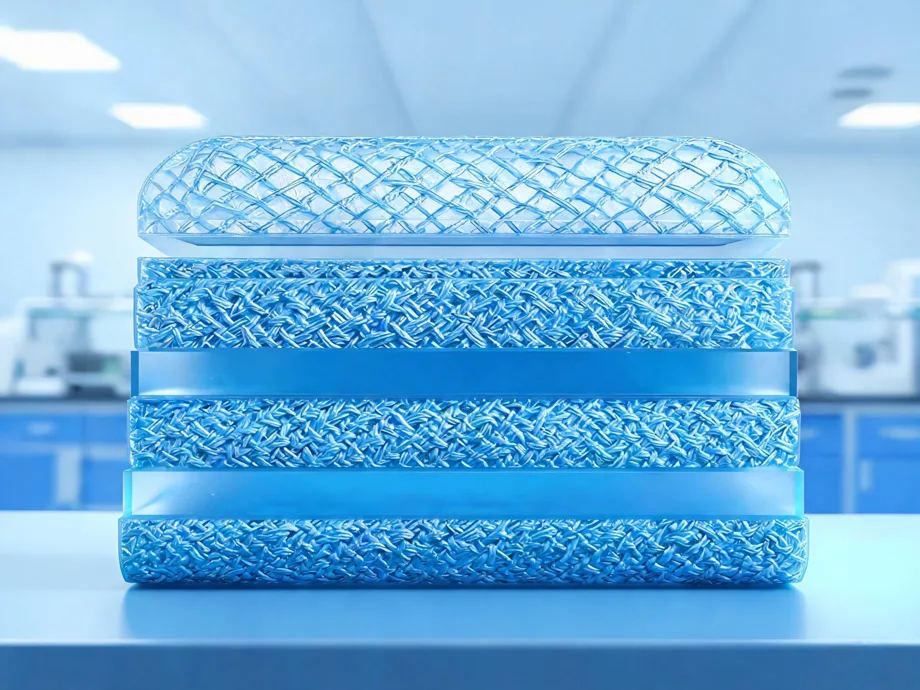
First, how satellites have historically shielded against debris. For decades the mainstream answer was the Whipple shield: hang a thin plate in front of the spacecraft wall with a gap, let the fragment shatter on the first layer, and by the time it crosses the gap and hits the inner wall its impact energy has been spread over a wide area. The logic is sound, but it has three unavoidable drawbacks — heavy (stacking metal plates, every kilogram is launch cost and fuel burden), litter-generating (metal blasted at high speed shatters into lots of secondary fragments, adding bullets to orbit), and signal-blocking (put a metal plate over an antenna and radio cannot pass; traditional shielding has to cut an opening at the antenna, and every opening is a hole you cannot defend). Space Armor’s composite version is clever because it is lighter than metal, produces essentially no secondary fragments on impact, and is radio-transparent — radio passes through, even radomes can use it — solving “holds up”, “stays clean” and “doesn’t block signals” all at once.
05 Behind the Data Is a Whole Industry Chain Turning
Do not underestimate this one panel. Behind it, satellite protection thinking is turning: from “passively hang more metal” to “use lightweight high-performance composites, accounting for weight, secondary debris and radio transparency together”. And this turn is not an isolated case — in September, a Dalian University of Technology team sandwiched a “water-filled aluminum egg-shell array” into a shield; simulations and light-gas-gun tests showed it sheared projectile velocity by nearly 65%, well above a single aluminum plate’s 51%. Biomimicry, composite materials, 3D printing — a batch of new routes are all pushing toward the same goal: lighter, more resilient, and clean. For the non-metal materials industry this is a true “vindication” signal — where space protection was once virtually metal’s domain, composites are moving from supporting role to lead.
06 Non-Metal Materials Stand Firm in the “Space Slot” on Three Ledgers
Why composites rather than stacking more metal? Break it down — three ledgers are being settled:
The lightweighting ledger: every kilogram into orbit is money. Under the iron law of “launch cost ≈ weight”, high-specific-strength materials that cut weight naturally win.
The secondary-debris ledger: shielding against fragments while creating fragments is the old disease of metal shielding; composites fail “cleaner”, producing almost no hazardous secondary debris — which directly decides whether a satellite is a “good orbital neighbor”.
The radio-transparency ledger: blocking nothing while letting radio pass is no longer just “protection” but doing two jobs at once — and for radomes and sensor fairings that must be transparent, impact-resistant, radiation- and temperature-tolerant, the material’s electrical performance and reliability are a gate that cannot be bypassed.
These three points all land within the reach of composites — and especially on the high-performance resin matrix step.
07 The “Foundation” of Composites Is That Invisible Resin Matrix
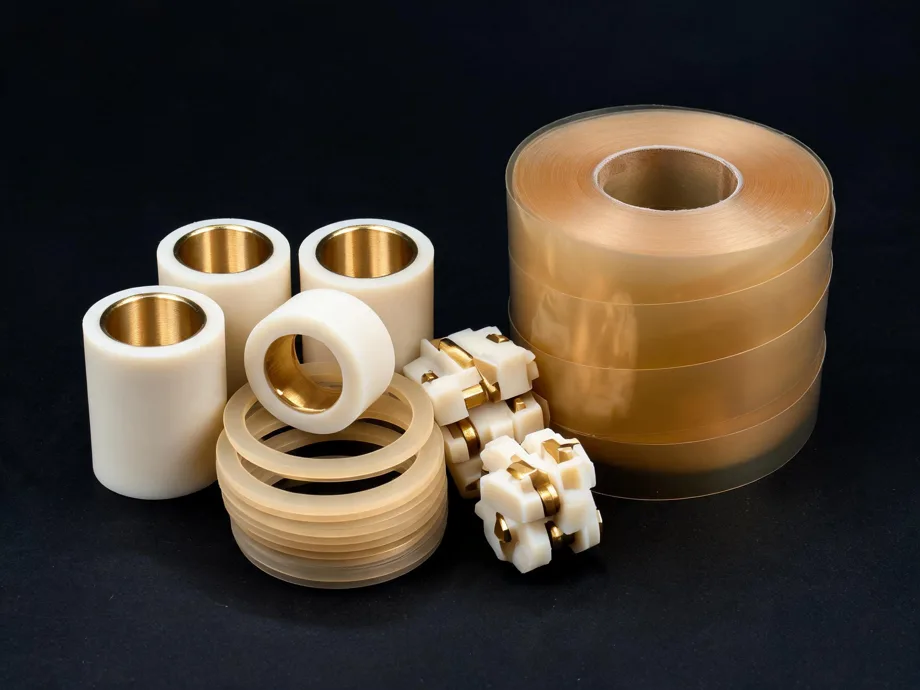
Many people think composite = fiber, but fiber is only the skeleton; what really decides whether it holds up is the resin matrix that “glues” the fiber together. In the polymer composite system Space Armor uses, the resin matrix must endure hypervelocity impact, vacuum outgassing, day-night temperature swings and ultraviolet irradiation — ordinary engineering plastics are not enough; you must reach into high-performance / specialty engineering plastics. Polyimide (PI) film is the traditional “foundation” of aerospace flexible substrates, insulation and radio-transparent structures — radiation-resistant, wide-temperature-range, dimensionally stable. And PEEK, with its high-temperature resistance, self-lubrication and low creep, is appearing more and more in satellite structural connectors, bearing bushings and precision insulator parts. The armor in the sky has become lighter and smarter — and that invisible resin matrix is the lifeline of whether it can hold up.
08 Domestic High-End Resin Matrices Are Filling That “Invisible Short Board”
Behind the narrative switch from “space protection by metal” to “composites on satellites” is a group of domestic makers of high-end specialty engineering plastics who have long been grinding away on this invisible track. Dalian Luyang Technology is deep in custom high-lubrication, high-strength PEEK modified systems and precision injection molding, supplying satellite joint bushings and precision structural parts — components that need “strength plus weight reduction and self-lubrication”; Beijing Yuchuan New Materials focuses on polyimide (PI) insulation and film, turning radiation resistance and dimensional stability into the “invisible foundation” for aerospace insulation, transparency and flexible substrates. Space debris grows by the day, and satellite protection’s shift from metal to composite will only harden. The key to winning this round is not whose armor is thicker, but who first makes that invisible resin matrix strong enough to hold up in space. From Dalian Luyang Technology, a specialty-engineering-plastics manufacturer working in PEEK, PI and PTFE modification and precision molding for satellite joint bushings, precision structural parts, seals and radio-transparent insulation.