
Here is the conclusion first: on October 21, 2026 at 11:39, the Taiyuan Satellite Launch Center used the GalaxyPower Ceres-1 sea-launch (No. 8) carrier rocket to send the “Xiguang No. 04 satellite” precisely into its intended orbit from the sea off Rizhao, Shandong. This star is no ordinary launch — it is the pioneer star of “Wuyang”, the world’s first low-inclination remote-sensing constellation, aimed squarely at the observation gap over the Guangdong-Hong Kong-Macao Greater Bay Area, South China and the Maritime Silk Road. As private commercial rockets fly denser and constellation deployment accelerates, demand is being pulled for satellite lightweight structural parts and rocket-shell composite materials at production scale.

01 A Private Rocket Carries a “World’s First” into the Sky
On October 21 at 11:39, the Wuyang constellation’s first star was entrusted to a private rocket and a maritime launch — that itself is a signal. Task-coded “Sea to Yangcheng”, it is the metaphor of “from the Yellow Sea to the Sheep City (Guangzhou)”. Co-built by the Guangzhou municipal government, the National Information Center and Guangzhou University, the Wuyang constellation strategically targets low-latitude areas in the 3.5–4.0°N band — the most population-dense, economically active region on Earth that has long suffered a supply gap in high-frequency, fast-response remote sensing.
02 Ceres-1: A Private Light-Class Rocket That Covers Both Land and Sea
Let’s make the star clear first. The Ceres-1 is a mid-small commercial launch vehicle developed by private aerospace firm GalaxyPower, using a “three-stage solid engine + liquid upper stage” four-stage configuration, about 20 m long, roughly 33 t at liftoff, with a capacity of about 300 kg to 500-km sun-synchronous orbit. Its special trait is that it can work from both land and sea platforms — lifting off from a conventional site or from the “Eastern Spaceport” launch vessel in coastal waters. Since its first flight on September 5, 2023, the Ceres-1 sea-launch version has completed 7 consecutive maritime launches with a 100% success rate — a mainstay for fast-response, high-density commercial launches.
03 Rockets Fly Denser: A Set of Numbers About “Volume Production”
Aerospace launches are already changing pace. From September 14 to now, China’s private commercial rockets have completed about 5 orbital launches, with multiple companies and technical routes fulfilling in parallel; October 14 saw Zhuque-2’s “11 satellites with one rocket” and October 21 saw Ceres-1’s maritime launch landing back-to-back. Zoom out: this year China’s launch count has hit a record for the same period, with September alone delivering a “ten-in-a-row all-success” scorecard. Maritime launch is no longer a “supplementary option” but a core growth pole — its flexibility in choosing orbit, mobile deployment and suitability for batch networking now underpins scaled commercial constellations.
04 The Remote-Sensing Constellation: An Opportunity Hidden in “Low Inclination”
Why does Wuyang deserve separate attention? For a long time nearly all mainstream remote-sensing constellations ran polar orbits, while the low-latitude band between 35°N and 40°S — covering the Greater Bay Area, South China, Southeast Asia and Africa, the most populated and economically active regions — has an urgent but long-unserved need for high-frequency, fast-response remote sensing. Wuyang goes straight at this gap: 3 pioneer satellites + 25 operational satellites, with the pioneer A-star running a 39° low-inclination orbit, carrying a 0.5-m-resolution high-res camera, a 2-m multispectral camera and a wideband infrared payload, serving natural-resource monitoring, ocean observation and typhoon/flood emergency response, built around “sense, transmit and use in real time”.
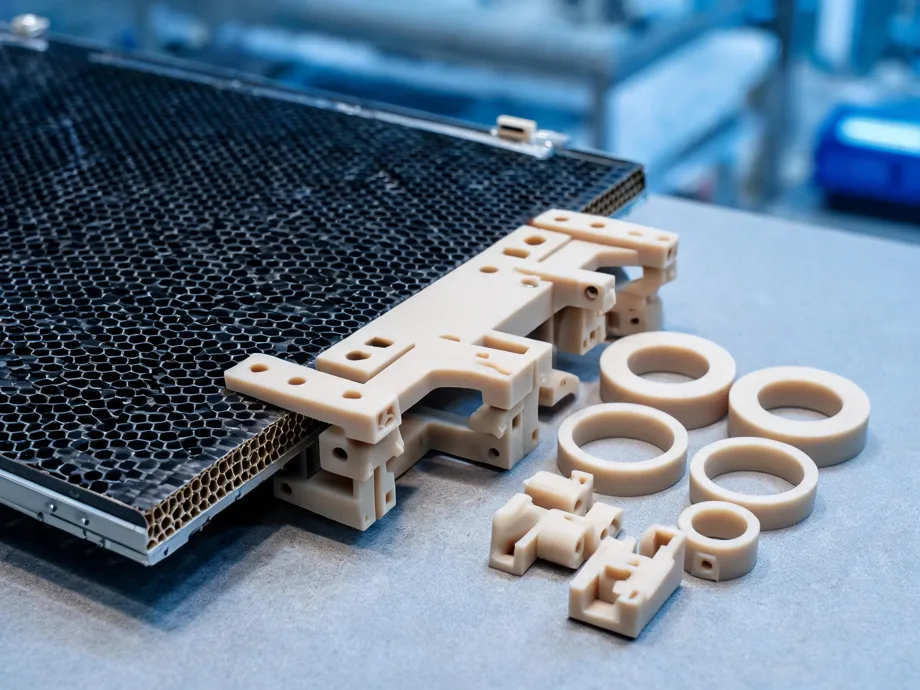
05 Satellites Must Be Lighter, Rockets Must Save Weight — Composite Materials Carry the Load
Scaling a constellation surfaces a plain physics problem: that many satellites must be built, must be light, and must be batch-launched into orbit. Competition between satellites and rockets is largely a “log-by-log” weight war. Every extra kilogram a satellite weighs raises its launch cost and attitude-control energy; every bit of weight shed from a rocket shell lets it carry one more satellite. So under the pressure of constellation and volume, satellite lightweight structures, high-specific-strength non-metal composite materials and rocket-shell composites have become decisive levers for cutting cost and raising efficiency — they must be strong enough and stiff enough, yet as light as possible, and remain stable long-term through dramatic temperature swings, vibration and vacuum. These “invisible structures” are the load-bearing foundation that decides whether a satellite stays put and whether a rocket can fit in one more star.
06 High Specific Strength, Environment Resistance, Dimensional Stability: Specialty Materials Claim Their Aerospace Slot
In these “light yet strong”-demanding aerospace scenarios, PEEK (polyether ether ketone) and high-performance specialty engineering plastics are materials repeatedly named. Several hard-won strengths hit the pain point of satellite/rocket structural parts dead-on:
High specific strength: density about 1.3 g/cm³, roughly 1/6 that of steel — used in satellite lightweight structures and brackets, “replacing metal with plastic” delivers real weight control;
Extreme-environment resilience: resistant to high/low temperature swings, radiation and low vacuum outgassing — suited to long-term in-orbit service;
Dimensional stability: little deformation from heat, humidity or pressure — precision-fit assembly holds its tolerance;
Fatigue resistance and anti-creep: stable over the long term under vibration and alternating load — right for rocket and satellite critical structural parts.
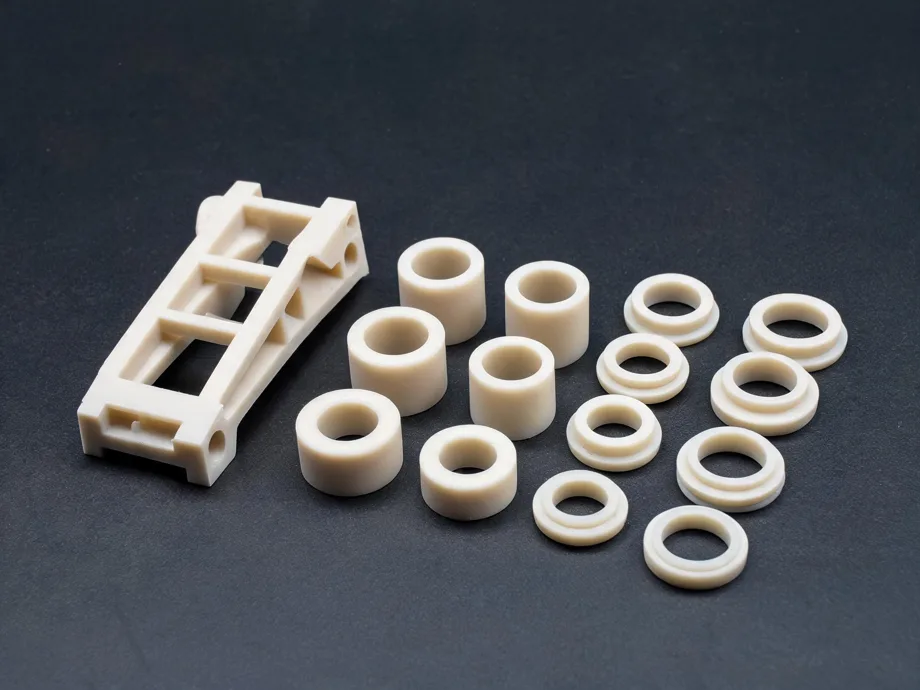
Satellite structural brackets, connectors, insulating seals and weight-reduction parts — for a satellite to “come down in weight and stay stable up in orbit”, PEEK claims a very large share.
07 From “Small-Lot Sampling” to “Batch Stability”, Material Is the Lifeline
A key turning point is underway: in the early days of commercial aerospace, material demand was “small lots, sampling, testing performance”; once it moves into constellation-scale batch networking, demand switches at once to “mass-producible, cost-reducible, stable long-term supply”. Modification and formulation, precision molding, batch consistency — the whole chain is real craft. This is precisely the window where specialty engineering plastics move from “import replacement” to “domestic autonomy” — a maker like Dalian Luyang Technology, long engaged in PEEK modified compounds with a one-line precision-molding capability, sits exactly on the “from material to part, stable supply” logic, at the main line of commercial aerospace volume production.
08 The Denser Rockets Fly, the Harder Materials Compete
One more maritime campaign for Ceres-1 looks routine, yet it is really the resonance of two tracks in commercial aerospace: maritime launches are becoming routine and high-density, and remote-sensing applications are going vertical and constellation-based. Once “can we reach orbit” stops being the question, “can we deliver stably, in batches, at controlled cost” becomes the new bar. And that new bar’s final landing point is often not in the flame and tower on camera, but in the satellite structure and rocket shell — that invisible layer of material that decides weight and reliability. The denser rockets fly, the fiercer the material race gets — whoever gives the better answer between “lighter” and “stable” holds the entry ticket to aerospace volume production. From Dalian Luyang Technology, a specialty-engineering-plastics manufacturer working in PEEK, PI and PTFE modification and precision molding for satellite lightweight structures, brackets, seals and rocket structural parts.