
Here is the conclusion first: for the first time the global top-5 humanoid-robot firms by revenue are all Chinese companies, but the race that really decides whether the industry goes from “show” to “use” — production work — has only just begun to scale. And right at this ramp-up moment, six national humanoid-robot standards have just landed: the industry is starting to account for the “parts ledger”, where joints, motors and dexterous hands have to hold up for years.
01 The Global Top-5 Is Now All Chinese
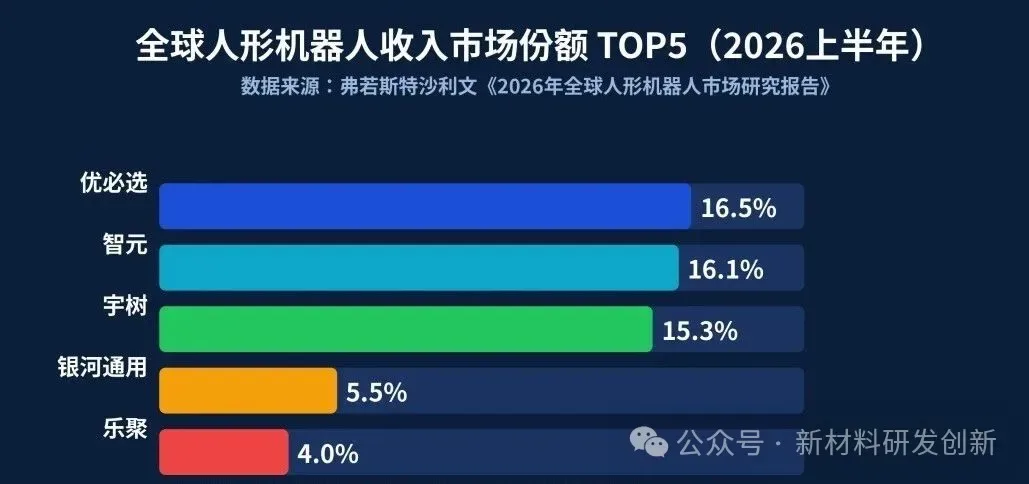
Frost & Sullivan’s 2026 Global Humanoid Robot Market Research Report paints an encouraging picture: H1 2026 global humanoid-robot sales reached 36,000 units, already exceeding all of 2025 (35,000); market revenue of $540 million also beat last year’s full total. More striking — by revenue, the global top five are all Chinese enterprises: UBTech, AgiRobot, Unitree, Galaxy General and Lehman, together taking about 57.4% share. Shenzhen customs data is equally hot: in the first 8 months, Shenzhen’s total robot exports reached RMB 11.13 billion, up 12.2x year on year, to more than 120 countries and regions.
02 But a “Working” Robot Has Just Left the Gate
Behind the bright numbers lies a calmer clue: the report splits applications into entertainment, research/education, data collection and production work. In H1 sales, entertainment models took the biggest share (about 57%); the truly “working” category — production work — earned about $78 million, up 65.9% from the whole of 2025 yet still small in size. In other words, the volume today is still mostly “performance” and “teaching” robots; what decides whether the industry moves from “show” to “use” is the production-work road — and that road demands a completely different order of reliable, long-term operation.
03 Six National Standards Landed = the Race Turns to Parts
Right at this ramp-up moment, on October 15 the State Administration for Market Regulation disclosed that the first batch of six national humanoid-robot standards was officially issued, to take effect April 1, 2027. Five are from the Humanoid Robot Technical Requirements series (general, environmental perception, decision planning, motion control, operation); one is the Humanoid Robot Simulation Test Platform Technical Specification — unifying what was previously “each vendor its own standard, each tests its own way”. For the first time, whether a robot is “smart, stable and can finish the job” has a measurable, verifiable, comparable yardstick. The moment standards land, the race shifts from “showcasing parameters” to comparing delivery, mass production and long-term stability — and reliability is concentrated precisely in the “invisible parts”: joints, electric drives and dexterous hands.
04 Joints Are the Lifeline: Most Overworked on Wear, Insulation and Sealing
For a humanoid robot to run around the clock in a factory, joints are the first place to be “overworked”. One joint actuator, one harmonic/planetary reducer, must carry high loads through repeated motions while coping with the temperature rise of long-running motors. Insulation frames, connectors and seals must survive high temperature, vibration and humidity for the long term without failing. Dexterous hands are harsher still — the shafts, gears and links of finger joints are high-frequency, micro-wear parts that must stay wear-resistant and dimensionally stable without losing precision. Every second a robot is “steady” is, in effect, a set of wear-resistant, heat-resistant, insulating, sealing materials holding the line.
05 “Replacing Metal with Plastic” Is Getting More Confident in Joints, Hands and Structure
In such long-serving joints, drives and transmission scenarios, PEEK (polyether ether ketone) keeps being name-checked as the specialty engineering plastic. It has four cards that hit the robot’s vital points: wear-resistant and self-lubricating — joint shafts, gears and bushings last longer under high-frequency friction, often self-lubricating, cutting wear and maintenance; high-temperature insulation — usable continuously at 260°C, so motor/drive insulation frames and connectors stay safe under load-induced temperature rise with excellent insulation; lightweight with high specific strength — density about 1.3 g/cm³, only about 1/6 that of steel, so “replacing metal with plastic” in structure and housing delivers real weight saving — a hard need for a robot that carries its own battery and must control weight; and dimensional stability — little deformation under humidity and temperature change, keeping precision transmission parts accurate.
06 From “Material” to “Part” on One Line, the Standardized Ramp Benefits First
The more valuable layer is this: once standards are set and volume ramps, the fastest to mature are domestic parts and domestic materials. In the early R&D phase, a robot’s need for materials is “small lots, sampling, testing performance”; once it scales to mass production, the demand instantly switches to “mass-producible, cost-reducible, long-term stable supply” — precisely the critical window for specialty engineering plastics to move from “import substitution” to “domestic autonomy”. Modification and formulation, precision injection molding, batch consistency — the whole chain is real craft. A maker like Dalian Luyang Technology, long engaged in PEEK modified compounds with a one-line precision-injection-molding capability, sits exactly on this “from material to part, stable supply” logic, at the main line of the ramp-up.
07 Standards Give a “Common Language”; Materials Decide How Long It Speaks
Six national standards give China’s robots a unified “common language”; a global top five of Chinese firms gives the industry long-term confidence. But beyond “talking the talk”, what decides whether a robot can actually keep turning for ten years in a factory is the wear parts inside its joints, the insulation in its motors and the sealing on its housing — components that have been “working overtime” since day one. Standards can define how “smart” a robot is and how steadily it works, but they cannot define how long the materials protecting that stability can last. How long materials last is precisely the step from “surviving” to “lasting” in domestic substitution. From Dalian Luyang Technology, a specialty-engineering-plastics manufacturer working in PEEK, PI and PTFE modification and precision injection molding for wear-resistant joint bushings, motor insulation frames, connector insulation seats and lightweight structural parts in humanoid robots.