Here is the conclusion first: at this year’s fair, visitors no longer ask whether a robot can do a backflip — they ask how many hours it runs a day, what its yield is, and how soon it pays back. IDC data shows humanoid-robot shipments jumped 432% year on year, yet the number that actually goes into a production line and works is still limited — the race is no longer about the “show”, but about years of stable “use”.

01 Same Halls, a Different First Question
The 26th China International Industry Fair (CIIF), held in Shanghai from October 12 to 16, covered 310,000 square meters, with 3,200+ companies from 24 countries and nearly 300 technologies and products making their debut. But the biggest change this year is not on the booths themselves — it is the first sentence visitors say. Wu Min, CTO of Elite Robots, put it bluntly: “Visitors used to love watching robots do backflips, write or paint; this year the most asked questions are how many hours a day this robot can run, what its yield is, and how long before it recovers the cost.”
02 Shipments Jumped 432%, But Fewer Are Actually Working
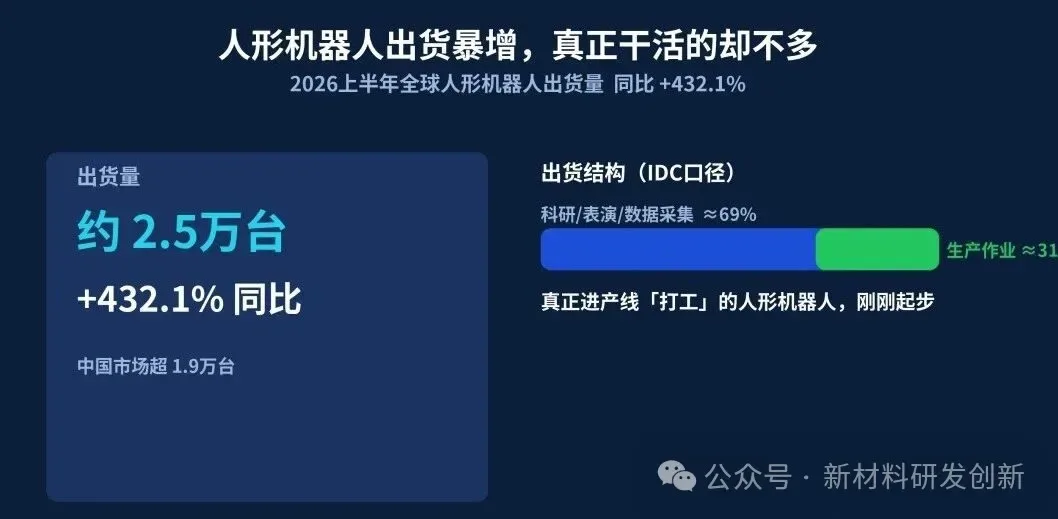
Pulling the lens back, the data speaks even more clearly. IDC data shows global humanoid-robot shipments in H1 2026 approached about 25,000 units, up 432.1% year on year, with China’s market exceeding 19,000 units. The numbers are explosive — but the same report also carries a half that is often overlooked: of these shipments, those used for scientific research/education, performance shows and government data-collection centers account for about 69%, while the share truly entering industrial production front lines is still limited. CIC Consulting (China Industry CBS) forecasts China’s humanoid-robot market at about RMB 3.4 billion in 2026, likely to break RMB 20 billion only by 2030.
03 Dozens of Successful Demos in the Hall Are Not the Same as Turning Around the Clock in a Factory
Why is there such a “split”? One analyst who has long studied the robot industry put a point on it: “Industrial scenarios require a robot to keep production rhythm and hold precision over the long term — that is a different thing from dozens of successful demos in a hall.” The buzz at this year’s CIIF is exactly the industry’s turning point from “technical validation” to “scaled delivery” — visitors are no longer satisfied with seeing “whether it can”, they begin to press on “whether it is dependable and whether it pays off”. Cost, reliability and ecosystem are widely seen as the three hurdles to large-scale embodied-AI deployment; among them reliability is the least conspicuous yet the most constraining — it maps to the long-term stability behind every second of a robot’s repeated motion, not one dazzling moment.
04 The Most Overworked Are the Invisible Parts in the Joints
To work reliably over the long term, the first thing to be “overworked” is the joint. One joint actuator, one harmonic or planetary reducer, carries high loads through repeated movements while also absorbing the temperature rise of long-running motors; insulation frames, connectors and seals must survive high temperature, vibration and humidity for the long term without failing. Dexterous hands are harsher still — the shafts, gears and links of finger joints are high-frequency micro-motion parts that must be wear-resistant and dimensionally stable without losing precision. Whether a robot can “tighten the same screw for ten years like it is day one” is decided to a large extent not in the algorithm but in the invisible parts of joints, electric drives and dexterous hands — wear resistance, heat resistance, insulation, sealing; every second of “steady” is these materials holding the line.
05 Wear-Resistant, Heat-Resistant, Insulating, Dimensional-Stable — Four Cards Played on the Vital Point
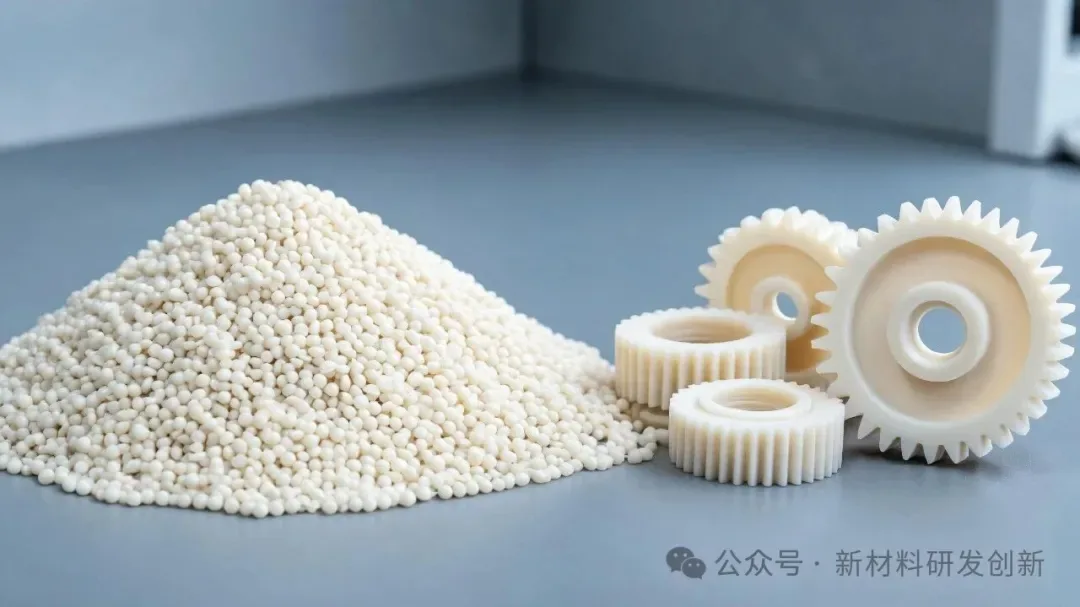
In these “long-service” joint/drive electric scenarios, PEEK (polyether ether ketone) is a specialty engineering plastic repeatedly name-checked. Its four cards hit the pain point of “from show to use”: wear-resistant and self-lubricating — joint shafts, gears and bushings last more stably under high-frequency friction, and in many cases self-lubricate, saving wear and maintenance; high-temperature insulation — usable continuously at 260°C, so electric-drive/motor insulation frames and connectors stay safer under high-load temperature rise with excellent insulation; lightweight with high specific strength — density about 1.3 g/cm³, about 1/6 that of steel, so structural parts deliver real self-weight control after “replacing metal with plastic”, a long-term value for a robot that must carry its battery; and dimensional stability — little deformation under humidity and temperature change, so precision transmission parts stay more accurate and durable. Joint bushings, drive insulation, dexterous-hand shafts, seals and structural parts — PEEK claims a very large share of “working long”.
06 From “Can Demo Once” to “Can Reliably Repeat”, Materials Are the Lifeline
A key pivot is happening: in the early days a robot’s need for materials was “small lots, sampling, testing performance”; once it moves from display toward mass production, the demand instantly switches to “mass-producible, cost-reducible, long-term stable supply”. Modification and formulation, precision injection molding, batch consistency — the whole chain is real craft. A maker like Dalian Luyang Technology, long engaged in PEEK modified compounds with a one-line precision-injection-molding capability, sits exactly on this “from material to part, stable supply” chain, at the main line where a robot must go from début to reliable repetition.
07 Doing a Backflip Is the Ticket; Working Long Is the Real Entry Pass
This year’s CIIF mirror reflects it clearly: whether a robot can do a backflip is no longer something anyone cares about; people now calculate how many hours it can run a year, whether yield is stable, and how soon it pays back. From “show” to “use”, the contest is no longer the brilliance of one action but long-term, steady reliability — and that layer of reliability ultimately lands on the wear parts in its joints, the insulation in its motors and the sealing on its housing; components that have been “working overtime” since day one yet never steal the spotlight. Doing a backflip is only getting a ticket; being able to do the same job year after year for ten years is what holds the entry pass — and a very large part of that confidence is given by materials. From Dalian Luyang Technology, a specialty-engineering-plastics manufacturer working in PEEK, PI and PTFE modification and precision injection molding for wear-resistant joint bushings, motor insulation frames, connector insulation seats and lightweight structural parts in humanoid robots.