
Here is the conclusion first: in mid-October 2026, the “2026 China Commercial Aerospace 3D Printing Technology Blue Book” was released (led by the MIIT Equipment Engineering Research Institute, Shanghai Additive Manufacturing Innovation Center and Huazhong University of Science and Technology), delivering a deceptively concrete verdict: 3D printing will rise from an “optional process” to a “standard technology” in aerospace. Market size, penetration rate, industrial chain — behind a string of numbers hides a harder signal: the way rockets and satellites are built is being completely rewritten.
01 More and More Rocket Parts Are Being “Printed”
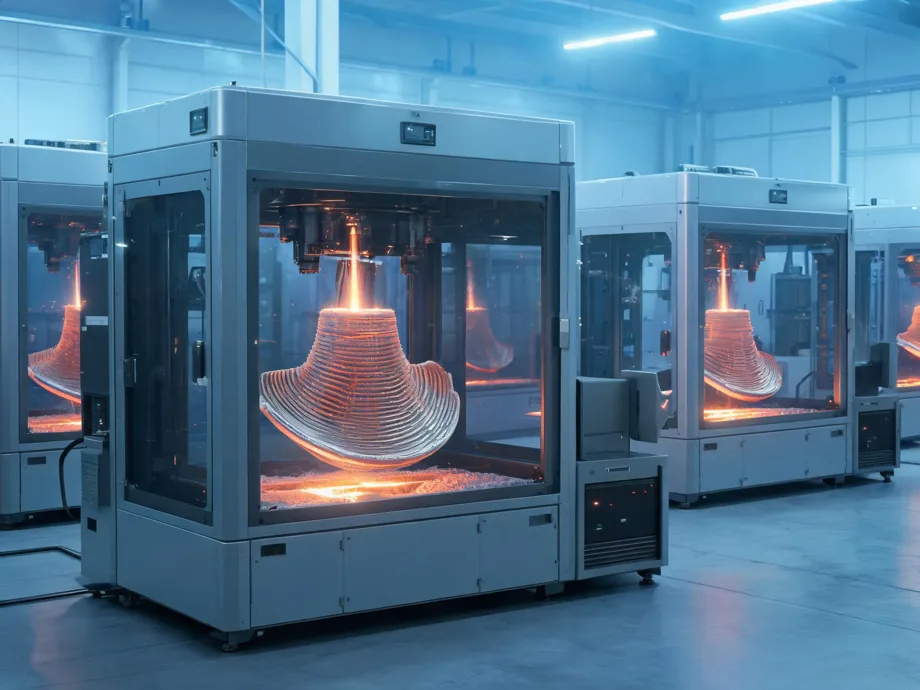
A fact most people do not know: today, on China’s commercial rockets, more and more core parts are not turned on a lathe — they are “printed” layer by layer. Walk into Wuxi Firikon’s workshop and you will see large laser printers running 24/7, with multiple laser beams melting metal powder grain by grain, progressively “drawing” a rocket-engine nozzle nearly a meter in diameter, as thin as a pencil sketch. Some twenty-plus days later, that “sketch" is finished through hot isostatic pressing and other steps into a nozzle delivered to a customer — about a meter tall. The trade calls this process metal additive manufacturing (3D printing), and it has already been used at scale in rocket manufacturing. This is not a laboratory demo but a mature process that has run into production: engine nozzles, thrust chambers and key structural parts across several commercial rocket models are being delivered in batches through metal 3D printing.
02 A Blue Book Draws the Timetable for the Industry
Just this month the Blue Book was released. Inside are a few numbers worth reading carefully: market size — China’s commercial-aerospace 3D printing market is expected to pass RMB 15 billion in 2027 and RMB 30 billion in 2030, with a five-year compound growth rate above 35%; penetration rate — in satellite structural parts, large-scale rocket-body structures and similar scenes, the penetration of 3D printing is expected to rise from today’s 35%–50% to above 60%; and a core judgment — raise additive manufacturing from “optional process” to “standard technology”. In one sentence: commercial aerospace 3D printing is moving from “let’s see if it works” to “this is how it will be built from now on”.
03 “Printed Rockets” Are Not a Gimmick — They’re Solid Logic
Why did this not-new craft suddenly “explode” in aerospace? Because rockets are naturally a perfect match for 3D printing. Rocket parts have a trait: extremely complex geometry, yet each model is made in runs of just one or two — classic high-complexity, low-batch production. Traditional processes either cannot machine such parts, or must assemble them from dozens or hundreds of pieces, with many welds and failure points. 3D printing solves both: one-piece forming — mergeable parts become one; and no mold needed — whatever the shape, just change the digital model and print. The data proves it. SpaceX’s Raptor 3 engine, which took about 500 parts to assemble traditionally, is pressed below 100 with 3D printing; Relativity Space’s Terran 1 put 85% of its structural mass in 3D-printed parts and cut components by more than 90% versus a traditional rocket; Space Pioneer’s Tianlong-2 TH-11V engine cut parts by 80%, shortened the manufacturing cycle by 70%–80%, and lowered cost and weight by 40%–50% each.
04 After Rockets, Satellites Move to the “Assembly Line”
Rockets are the vanguard; the real volume is in satellites. In the past, satellites were “hand-carved one at a time”. Now the logic has flipped: with ten-thousand-unit low-orbit constellations and reusable-rocket batch deployment, satellites must be produced at tens or hundreds per year, and manufacturing them one by one is simply too slow. So “printed satellite structural parts” is ramping up — satellite structural brackets, connectors and thermal-insulation parts are shifting from “specially customized” to “batch printed, batch-consistent, cost-reduced”. This is the bottom meaning of the Blue Book’s 35%–50% → 60%+ penetration line: as satellites are built faster, the process must keep up. And once “built fast” is achieved, a harder question is pushed to the front: can the material be supplied reliably and consistently?
05 Batch Production Tests the Invisible “Consumable”
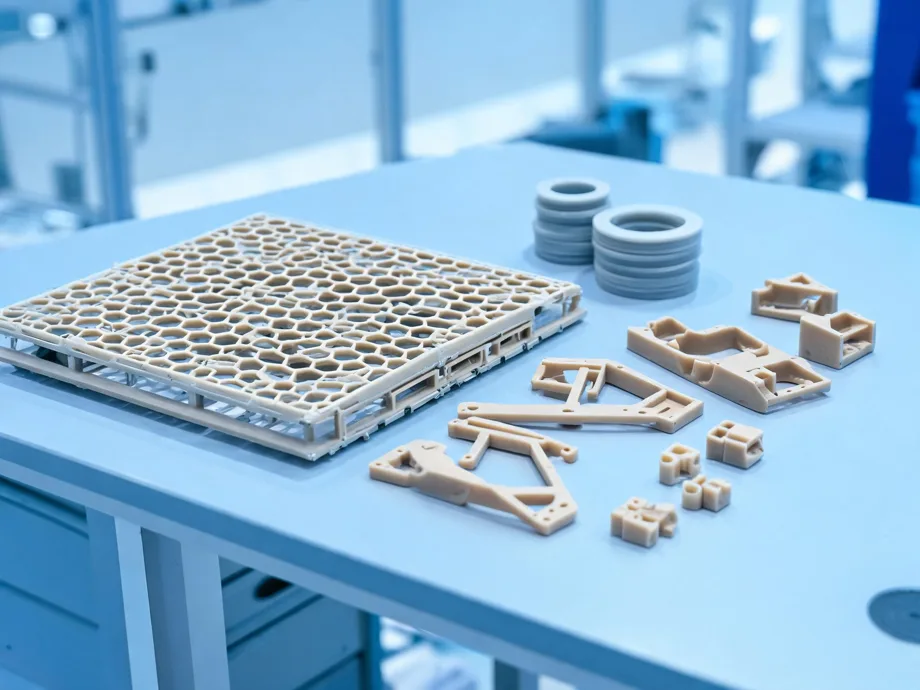
Many people think 3D printing is about the machine; in the end it is about the material. However fast the equipment, if the consumable is unstable the parts are scrapped; and when an aerospace-grade part is scrapped, reworked or reprinted, cost and time both double. A pain point heard often in the market is that “high-end metal powder and specialty consumables are expensive to procure, and machine depreciation and consumable loss dominate production cost”. For the non-metal track this too is a life-and-death matter: a satellite’s connectors, structural parts and precision insulator parts must survive vacuum, hard radiation and extreme temperature swings, and also be printable, batch-stable and low-outgassing — which directs the requirement toward high-temperature, high-strength, dimensionally stable specialty engineering plastics, above all PEEK (polyether ether ketone). Metal printing is the skeleton; the non-metal parts inside a satellite that “must both be light and survive high temperature and be batch-producible” are exactly where specialty engineering plastics belong.
06 PEEK: The Ceiling of the “Printable High-Temperature Plastics”
Why PEEK and not an ordinary plastic? Because the demands on satellite batch parts are extremely stringent, and every one happens to land on PEEK’s strengths: high-temperature resistance — usable long-term at 260℃, so it survives both printing heat and service heat; light — density about 1.3 g/cm³, roughly a sixth of steel, and weight reduction equals savings; dimensional stability — low water absorption and low thermal expansion, so printed parts are dense with little warpage and good batch consistency; and high strength, wear resistance and low outgassing — it does structural parts and joint bushings alike, and stays stable under vacuum and radiation. In one sentence: when a satellite structural part must be both “printable” and “high-temperature, high-strength, low-outgassing”, PEEK becomes an inescapable material option. Metal solves the “skeleton” and non-metal PEEK solves the “joints, sealing and insulation” — not substitutes, but parts that work together.
07 Domestic PEEK Is Filling the “High-End Consumable” Gap
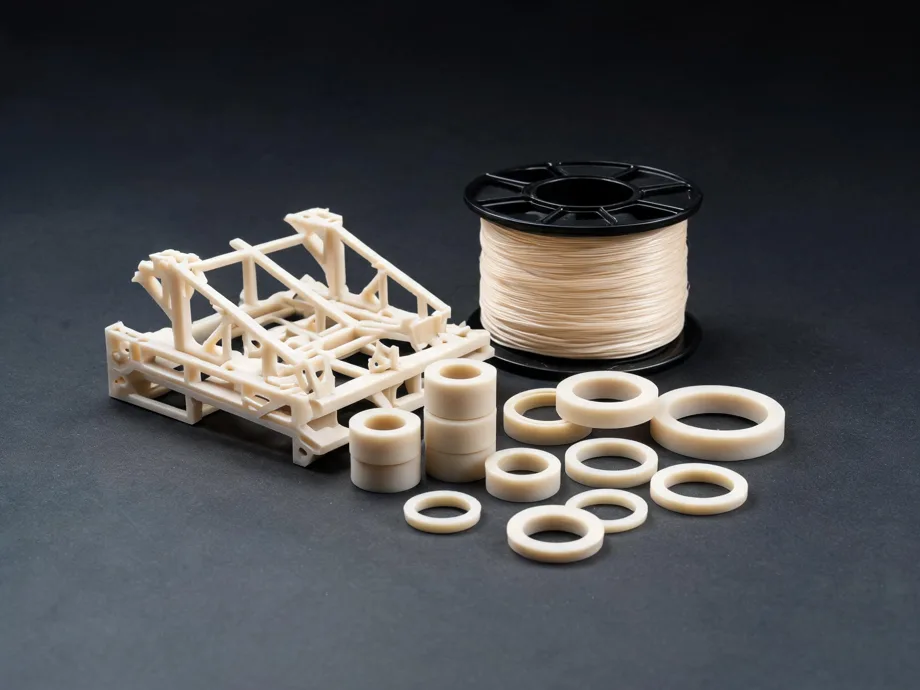
In the past, high-end specialty engineering-plastic filament, rods and structural parts were mostly imported. The Blue Book puts it bluntly: for 3D printing to leap from the mid-low end of the value chain to the high end, breakthroughs in the material and equipment links are key — and localization is the path. Dalian Luyang Technology has long dug deep into custom high-lubrication, high-strength PEEK modified systems and precision injection molding, turning wear-resistant, high-temperature, dimensionally stable PEEK into the satellite structural parts, connectors and wear-resistant bushings that “must be printable, survive high temperature and stay batch-stable” — filling, exactly, this domestic slot of the “invisible consumable”. The Blue Book’s direction is clear: behind the RMB 30 billion tank and the 60%+ penetration of 2030 stands not just row after row of printers, but batch after batch of stably supplied material. Rockets can be “printed”, satellites can be “printed” — but high-end material cannot be “printed”. It has to be built meter by meter, company by company, all the way through. For 3D printing to become standard, the localization fight for materials has only just begun. From Dalian Luyang Technology, a specialty-engineering-plastics manufacturer working in PEEK, PI and PTFE modification and precision molding for satellite structural parts, connectors, wear-resistant bushings and precision insulator parts.