At 6 p.m. on 2 October 2026, at the northern edge of the Taklamakan Desert, the Zhentan 1 well of Tarim Oilfield was completed at a depth of 8,345 meters. This was not an ordinary deep well — it was the second ultra-deep well drilled by China’s first domestically developed 12,000-meter automatic ultra-deep drilling rig. Its previous feat: the 10,910-meter “Deep Earth Take-1”, Asia’s deepest vertical well. Just before completion, on 1 October, the well recovered a 6-meter continuous core at 8,080 meters — source rock of the Cambrian Yu'ertusi Formation, resting underground for 500 million years, the first time Tarim’s northwest margin has reached the “mother rock” of hydrocarbon generation at this depth.
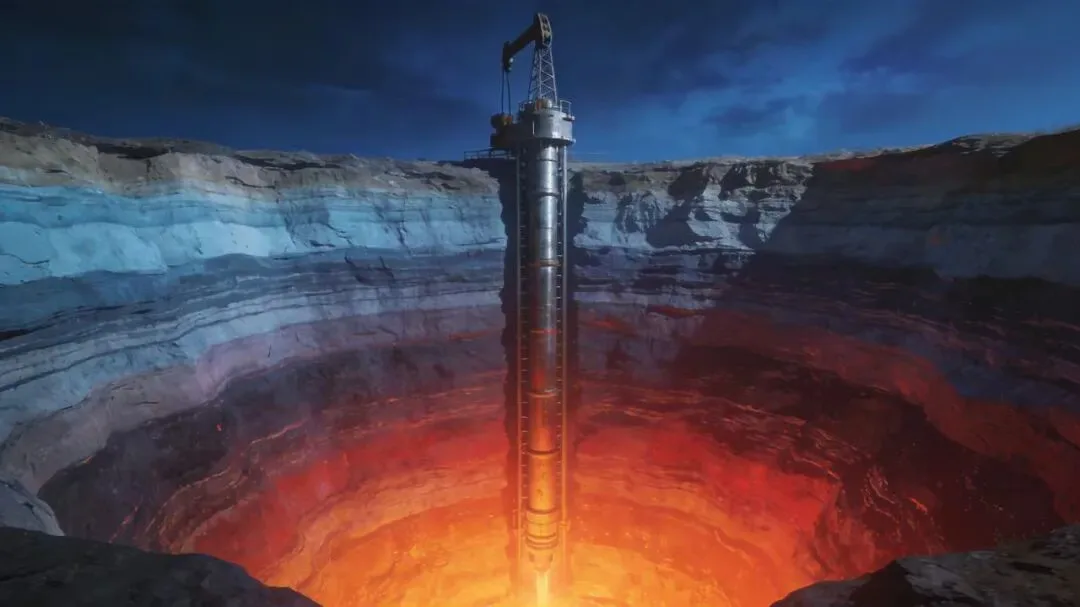
By 2026, Tarim Oilfield has drilled more than 270 wells deeper than 8,000 meters — over half of the national total. The signal is clear: 10,000-meter deep-earth drilling is shifting from a “super project” into “routine operation”. What turns the extreme into the everyday, however, rests on two materials of stark contrast — one so hard it takes 80,000 atmospheres to make, the other so tough it can hold up for years in a 220°C wellbore. This article tells both stories.
First, the Data: What a 10,000-Meter Well “Hell” Looks Like
Put the official numbers into plain terms. Depth: 10,910 meters — if you dropped in Mount Everest, its summit would still be more than 2,000 meters short of the well bottom, across 12 rock formations with entirely different lithology and pressure systems. Temperature: up to about 220°C at the bottom — above the boiling point of cooking oil. Pressure: 145 MPa at the bottom; China’s National Energy Administration puts it as the equivalent of 1.45 tonnes pressing on a fingernail-sized area — roughly a family car standing on your thumbnail. Load: more than 1,130 drill pipes linked end to end, self-weight exceeding 350 tonnes, the thinnest pipe only fist-thick and limp as a noodle; an 82-meter steel derrick must hold a 665-tonne extreme load — CCTV likens it to lifting 100 adult African elephants. Time: the tell-tale metric. Reaching 10,000 meters took 279 days, a global onshore record, but the “final kilometer” to completion took 300-plus days — daily progress under 3 meters. The first 10,000 meters is a sprint; the last kilometer is the agony.
And the well is only half of it. Once oil and gas are produced, the surface wellhead must precisely control even higher pressure — Tarim’s self-developed 175 MPa ultra-high-pressure wellhead and supporting equipment was named a 2026 major achievement of the Zhongguancun Forum, filling a gap in China’s ultra-deep safe production equipment. From well bottom to wellhead, every meter is a material’s ultimate exam.
The Hardest Link: the “8 Elephants” in the Title Are the Drill Teeth
No drill bit, no oil. The first life-or-death gate of a 10,000-meter well is the bit. Tarim’s ultra-deep strata are brutally tough — as People’s Daily describes, the ultra-deep dolomite is extremely hard, and intermittent chert is “like stones hidden in bean curd”, cracking drill teeth during cutting. The strata alternate soft and hard — some like rubber candy, others like fruit candy — a continuous torture test for the teeth.
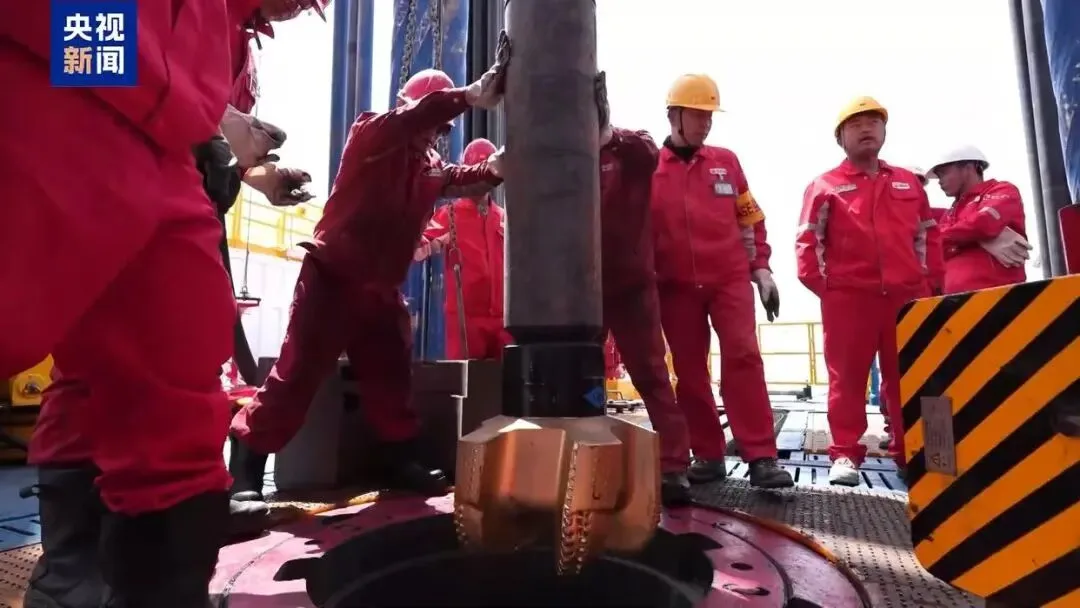
China fits its bits with PDC — polycrystalline diamond compact: an ultra-hard composite of synthetic diamond micro-powder sintered onto a tungsten-carbide substrate. Tarim’s exploration lead told CCTV its manufacturing conditions: 1,500°C and 80,000 atmospheres. What is 80,000 atmospheres? CCTV’s analogy is the source of our title — the pressure of 8 elephants weighing 10 tonnes each, standing simultaneously on a fingernail-sized area. No figure of speech: it is the real pressure this drill tooth endures leaving the factory. And here is the key point: this once-imported core bit material has been localized through technology introduction and R&D upgrading — Chinese-made PDC bits now break through ultra-hard strata below 8,000 meters, becoming the spearhead of deep-earth operations. One of the hardest man-made materials on Earth now carries a “Made in China” label.
The Softest Shortfall: Strong Enough for 80,000 Atmospheres, but Hurting in a “Seam”
The drill bit is the hero, but a downhole tool is not one piece — it is assembled from countless parts: sealing by seals, circuit insulation by insulators, instrument chambers by support rings. Steel offers a relatively easy answer (domestic BG155V-grade casing with strength over 1,068 MPa holds its grade at 220°C) — but the traditional rubber in “seams” and on “faces” cannot hold up. First, high-temperature carbonization aging. Ordinary nitrile and fluororubber accelerate hardening, cracking and losing elasticity in the 150–200°C downhole environment. The moment a seal fails, high-pressure drilling fluid rushes into the instrument chamber and the million-yuan MWD measurement equipment dies on the spot. Second, high-pressure extrusion. Under a differential pressure of over a hundred MPa, a rubber O-ring is literally squeezed into the gap between metal parts — like dough forced through a sieve, a failure called extrusion. The softer the rubber, the faster it squeezes. Third, chemical attack. Deep Tarim fields are high in sulfur: hydrogen sulfide, carbon dioxide and high-salinity brine attack in turn. Rubber swells and blisters in acidic gas, and on rapid decompression “explosive decompression” occurs — gas tears through the rubber from inside and the seal shatters. When a downhole sensor goes “blind”, it is like a person suddenly losing sight while walking. Many 10,000-meter near-misses are rooted not in the drill bit, but in a centimeter-sized sealing ring.
The Toughest Link: 220°C Drilling Fluid, and the Plastic That Replaces Rubber
As rubber steps down, two positions are taken by new materials. The first is the wellbore itself — the drilling fluid, the “blood” of drilling that carries cuttings, balances formation pressure and cools the bit. After thousands of trials and optimizing hundreds of materials, Tarim’s drilling-fluid team developed an ultra-high-temperature water-based polymer drilling fluid system resistant to 220°C — its core additives rely on rigid polymer-molecular-chain design (introducing rigid groups such as benzene rings and amphoteric anti-salt groups) plus nanoscale sealing material, keeping rheology and filtration loss stable at 220°C in high-salinity downhole. Matched 240°C-resistant cement slurry set the record for the world’s deepest cementing job at 10,910 meters.
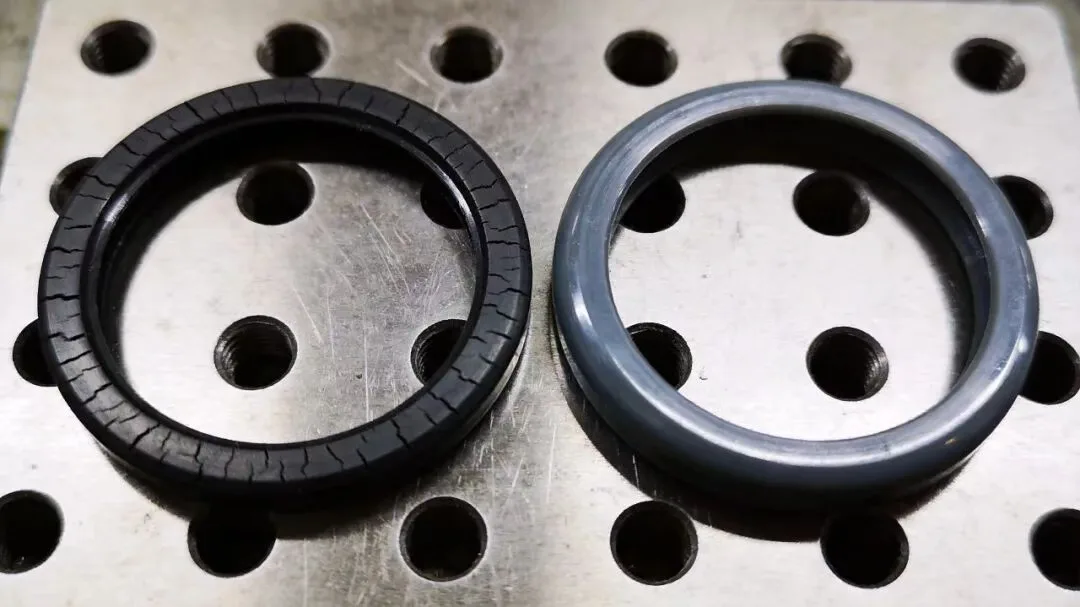
The second is rubber’s old job — high-performance engineering plastics. The international downhole-tool industry’s answer for over a decade has been PEEK (polyether ether ketone) and its carbon-fiber / glass-fiber reinforced modification family:
- Heat and pressure resistance: continuous service to 260°C; leading manufacturers cite up to 207 MPa for sealing support rings and electrical connectors — more than 40% margin over the 145 MPa at a 10,000-meter well bottom — and passing the NORSOK M710 sour-gas aging test.
- Sealing support rings (back-up rings): clamped behind the O-ring to carry high pressure and stop it being forced into metal gaps. An industry case: a 30% glass-fiber-reinforced high-temperature PEEK injection-molded support ring keeps its mechanical performance at 170°C where standard rubber parts cannot, markedly extending downhole pump service intervals.
- MWD/LWD electronic chambers — the downhole “nervous center”: PEEK’s insulation resistance protects signals and its creep resistance holds dimensional precision; its electrical connectors carry twice the power of glass-ceramic.
- Valve seats and packers: public industry cases show carbon-fiber-reinforced PEEK sealing rings run stably for 5+ years at 180°C and 140 MPa, while conventional solutions need replacing every 2 years.
Do the math: offshore drilling day-rates run to hundreds of thousands of dollars, and a deep well shut in for seal failure loses far more in delay. The hardest diamond cracks rock; the toughest polymer “survives”. Two materials at opposite extremes — not a gram of either can be wrong.
After Ultra-Deep Becomes Routine: Downhole Non-Metal Is the Next Localization Gate
Ultra-deep wells moving from “special case” to “the norm” means demand for premium downhole consumables shifts from “research-custom” to “bulk supply”. Three signals: first, downhole temperature/pressure ratings keep climbing — China’s first 86-type ultra-high-temperature, ultra-high-pressure perforator is rated 260°C and 245 MPa, setting a world depth record for perforating; the new ultra-deep well in the Junggar Basin reaches 224.6°C and 230 MPa at bottom, more extreme than Take-1. Second, 175 MPa wellheads, blowout preventers and well-testing equipment have landed domestically one after another, closing the loop of surface and downhole equipment chains. Third, the 12,000-meter domestic rig is already on its second well, and the count of wells below 8,000 meters keeps growing by dozens per year.
This is the window for domestic high-temperature modified materials. Downhole tools never ask for “resin” in one word: carbon-fiber reinforcement lifts stiffness and creep resistance, wear modification fights erosion by sand-laden drilling fluid, the temperature class matches 220°C+ sections, and seals demand batch-consistent precision injection molding. Resin is the base; the modified formulation and processing are the gate for getting parts into the well. Domestic PEEK resin capacity is already up — turning resin into sealing rings, support rings and insulators that dare go into a 10,000-meter well is the last kilometer of this supply chain’s localization. These downhole PEEK parts are exactly the main battlefield of domestic specialty engineering plastics.
Conclusion: Every Meter into the Earth Is a Material Test
Humanity goes up to a space station floating in a 400-km vacuum, and down with a bit sunk 10,000 meters into rock. The common thread: every meter pushed toward the limit is material taking on what a machine cannot. The deepest story of drilling 10,000 meters is never the rig’s horsepower — the drill teeth need synthetic diamond baked at 1,500°C and 80,000 atmospheres, the wellbore needs polymer drilling fluid tuned by thousands of trials, and the seams — the sealing and insulation at depth — are held together ring by ring by high-temperature, high-pressure, sour-gas-resistant high-performance engineering plastics. The hardest, the toughest and the least conspicuous: miss any one and the well never reaches 10,000 meters. From the subsea christmas tree at 10,000 meters of water, to the drill bits and seals at 10,000 meters underground — deep sea and deep earth are two exams of the same material-industrial question, and China’s answer keeps writing deeper. From Dalian Luyang Technology, a specialty-engineering-plastics manufacturer working in PEEK, PI and PTFE modification — carbon/glass-fiber reinforcement for stiffness and creep resistance, PTFE and graphite for self-lubrication — with precision injection molding for sealing support rings, insulation parts and MWD/LWD chamber components.